You Won’t Believe What I Found in Genoa
Genoa, Italy, isn’t just a pit stop—it’s a cultural treasure hiding in plain sight. I went expecting old streets and seafood, but left stunned by its layered history, vibrant alleyways, and authentic Ligurian soul. This isn’t Florence or Venice; it’s raw, real, and refreshingly untouched. From ancient port tales to hidden piazzas humming with local life, Genoa reshaped how I see Italian culture. Let me take you through the moments that made my trip unforgettable.
First Impressions: The Pulse of a Forgotten Port City
Stepping off the train at Genova Piazza Principe, one is immediately struck by the city’s unapologetic authenticity. There are no sweeping red-tiled rooftops or grand piazzas framed for postcards—instead, Genoa reveals itself in fragments: a sliver of turquoise sea glimpsed between weathered buildings, the scent of frying seafood curling through narrow streets, the distant hum of cargo ships maneuvering in Europe’s busiest Mediterranean port. This is not a city preserved behind glass. It breathes, works, and lives with a rhythm all its own. Unlike the polished elegance of Rome or the watery spectacle of Venice, Genoa wears its centuries like a well-loved coat—faded in places, but warm and full of character.
The city’s maritime soul is evident from the start. Founded by the ancient Ligures and later shaped by the powerful Genoese Republic, Genoa thrived as a naval superpower during the Middle Ages and Renaissance. Its strategic coastal position made it a hub for trade, exploration, and cultural exchange. Today, that legacy lingers in the salt-tinged air, the cobbled lanes sloping toward the water, and the proud stance of its historic palazzi. The port, still active and industrial, pulses with container cranes and ferry departures, a reminder that Genoa has never stopped working. Yet within this functional heartbeat lies beauty—spontaneous and uncurated. A fisherman mends his net beside a 15th-century church; children play soccer in a sunlit courtyard once used by merchant families. These moments aren’t staged. They are the quiet poetry of daily life.
What sets Genoa apart is its refusal to conform to tourist expectations. There are no roped-off zones or entrance fees for simply walking down a street. Visitors are not separated from residents but become temporary participants in the city’s rhythm. The worn stucco facades, stained by time and sea spray, speak of resilience. The uneven stones underfoot bear the imprint of centuries. Even the light has a unique quality—softened by humidity, reflecting off marble and water in gentle glimmers. For those willing to wander without a fixed itinerary, Genoa offers a rare gift: the chance to experience Italy not as a postcard, but as a living, evolving story.
Walking the Caruggi: Where History Whispers in Every Turn
The true heart of Genoa lies in its caruggi—the narrow, winding alleyways that form a labyrinth beneath the city’s historic center. These medieval passageways, some barely wide enough for two people to pass, twist and climb like veins through centuries-old stone. Walking them feels like stepping into a different dimension, where time moves slower and every turn reveals a new vignette of local life. Laundry strings stretch overhead, fluttering like flags between balconies. Elderly women peer from latticed windows, calling out to neighbors below. The scent of garlic and rosemary drifts from open kitchen doors, mingling with the earthy aroma of damp stone.
Each caruggio has its own personality. Via San Luca, one of the oldest, is lined with family-run shops selling handmade pasta, cured olives, and jars of freshly made pesto. Further on, Via della Maddalena buzzes with students and artists, its walls adorned with subtle street art and chalked poetry. These alleys were not designed for tourists or grand processions but for utility—connecting homes, workshops, and markets in a dense urban fabric that once housed thousands within a compact hillside. Their survival is a testament to Genoa’s layered history, where Roman foundations support Renaissance facades, and Baroque churches nestle between modern bakeries.
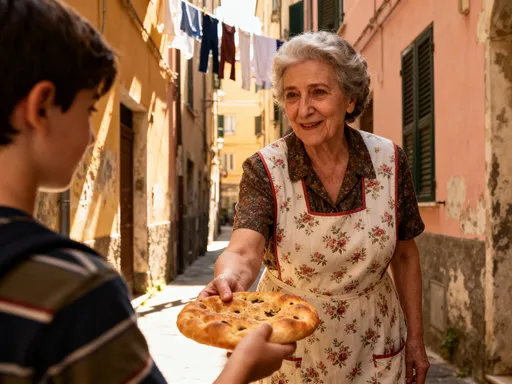
But beyond their architectural charm, the caruggi are living spaces. They host traditions passed down through generations. In a tucked-away workshop near Caruggio San Donato, an elderly artisan demonstrates the art of *merletto genovese*, a delicate form of bobbin lace that flourished in the 17th century. Using centuries-old patterns, she weaves intricate designs by hand, her fingers moving with quiet precision. Nearby, a small bakery sells *focaccia al formaggio*, a lesser-known local specialty where cheese is baked directly into the dimpled bread, creating pockets of golden, gooey richness. These are not museum pieces but everyday expressions of culture—accessible, unpretentious, and deeply rooted.
To walk the caruggi is to engage in slow travel at its finest. There are no timed entries or audio guides—just observation, curiosity, and the occasional smile exchanged with a local. The city reveals itself in fragments: a glimpse of a hidden courtyard with a lemon tree in a terracotta pot, the sound of a violin practice drifting from an upper window, the sudden opening of a small piazza where neighbors gather in the evening. In these moments, Genoa doesn’t perform. It simply exists—and in doing so, offers a rare kind of intimacy.
The Legacy of the Sea: From Columbus to the Modern Port
No understanding of Genoa is complete without acknowledging its relationship with the sea. For over a thousand years, the Mediterranean has shaped the city’s destiny—fueling its rise as a maritime republic, enriching its architecture, and defining its cuisine. Christopher Columbus, born in Genoa in 1451, is perhaps the most famous symbol of this seafaring heritage. His childhood home, a modest stone building in the caruggi, stands as a quiet monument to the city’s outsized role in global exploration. But Columbus is only one thread in a much larger tapestry. At its peak, the Genoese Republic controlled trade routes across the Black Sea, North Africa, and the Levant, amassing wealth that funded the construction of opulent palaces and fortified towers.
That wealth is still visible today in the UNESCO-listed *Le Strade Nuove* and the *Palazzi dei Rolli*. These 16th- and 17th-century streets—particularly Via Garibaldi, once called Strada Nuova—were designed to showcase the power of Genoa’s merchant elite. The palazzi lining the avenue feature grand staircases, frescoed ceilings, and manicured courtyards, their facades adorned with intricate stonework. What makes them remarkable is not just their beauty but their historical function: they were part of a public lodging system where visiting dignitaries were hosted in private homes, a practice so unique it earned UNESCO recognition. Today, several of these palaces operate as museums, offering a glimpse into the opulence that sea trade once financed.
Yet Genoa’s maritime identity is not confined to history books. The modern port, stretching for miles along the coastline, remains one of the largest and most active in Europe. It handles everything from cruise ships to cargo containers, serving as a vital economic engine. Unlike cities that have turned their backs on industrial zones, Genoa integrates its port into daily life. The Ferry Terminal connects the city to Corsica, Sardinia, and Sicily, making Genoa a gateway to the Mediterranean. Fish markets operate at dawn, where local chefs and families select the day’s catch—branzino, octopus, and red shrimp from the Ligurian Sea. Even the city’s dialect, a melodic blend of Italian and old Ligurian, carries nautical terms and expressions born from centuries of seafaring.
The sea also influences Genoa’s cuisine in profound ways. Anchovies from nearby Cetara are preserved in salt and used in countless dishes. Salt cod, once a staple for long voyages, remains a beloved ingredient in winter stews. And the city’s famous pesto, made with local basil from Pra’—a seaside neighborhood—relies on the region’s mild climate and fertile soil. Every bite carries the taste of the coast. For visitors, a boat tour along the harbor offers a unique perspective—seeing the city from the water reveals its true scale and orientation, a vertical urban cascade descending toward the waves.
Flavors of Liguria: Beyond Pesto and Focaccia
While Genoa is often credited as the birthplace of pesto and Ligurian focaccia, its culinary identity extends far beyond these iconic dishes. To eat in Genoa is to participate in a culture where food is seasonal, communal, and deeply personal. There are no rigid menus in many family-run *trattorias*—instead, the owner might gesture toward what’s fresh that day: wild greens sautéed with garlic, trofie pasta tossed with fresh pesto, or stuffed zucchini flowers fried to golden perfection. Meals unfold slowly, often beginning with a slice of warm focaccia, its surface glistening with olive oil and coarse salt.
One of the most authentic experiences is sampling *farinata*, a savory chickpea pancake baked in wood-fired ovens. Sold by the slice at small kiosks throughout the city, it emerges crisp on the outside, creamy within, often sprinkled with rosemary and black pepper. It’s a humble dish with noble roots—historically eaten by sailors and laborers for its high protein and long shelf life. Today, it’s a beloved street food, best enjoyed while standing at a counter with a paper napkin in hand. Another regional specialty is *pansoti*, triangular ravioli filled with ricotta and wild herbs, typically served with a walnut sauce that balances richness with earthy depth.
Equally important is the ritual of dining. In Genoa, meals are not rushed transactions but moments of connection. Families gather for long Sunday lunches, often beginning with antipasti platters of cured meats, marinated vegetables, and local cheeses. Even in casual settings, there’s an unspoken respect for the ingredients and the hands that prepared them. Wine plays a supporting role—often a crisp white from the Ligurian hills or, for special occasions, a rare glass of *sciacchetrà*, a sweet dessert wine from the terraced vineyards of the Cinque Terre. Produced in tiny quantities, it carries notes of dried fig, honey, and apricot, a liquid testament to the region’s dedication to artisanal craftsmanship.
For those eager to go deeper, cooking classes led by local nonnas offer a hands-on way to learn traditional techniques. These are not commercialized demonstrations but intimate gatherings in home kitchens, where participants learn to roll trofie by hand, crush basil with a mortar and pestle, and balance flavors without measuring spoons. The lesson is not just about recipes but about philosophy—how food connects people to place, season, and memory. In Genoa, eating is never just about sustenance. It’s a language of care, continuity, and belonging.
Hidden Cultural Gems: Museums and Music You’ve Never Heard Of
Away from the well-trodden tourist paths, Genoa harbors a wealth of cultural treasures that speak to its intellectual and artistic legacy. The Strada Nuova museums—comprising the Palazzo Rosso, Palazzo Bianco, and Palazzo Doria Tursi—are often overlooked in favor of Florence or Venice’s more famous galleries, yet they house masterpieces by Caravaggio, Rubens, and Van Dyck, collected by Genoa’s wealthy merchant families. The Palazzo Bianco, in particular, offers a beautifully curated journey through Ligurian art, from medieval religious panels to 19th-century landscapes capturing the region’s luminous coastline.
Equally compelling is the Accademia Ligustica di Belle Arti, one of Italy’s oldest art academies, founded in 1751. Its archives contain centuries of drawings, engravings, and student portfolios, offering a rare glimpse into the evolution of artistic training in northern Italy. While not all collections are on public display, guided visits can be arranged, revealing forgotten sketches and academic studies that reflect the city’s enduring commitment to creativity. Nearby, the Museo del Tesoro di San Lorenzo safeguards religious artifacts from the city’s cathedral, including a fragment of the Holy Grail according to local tradition—a powerful symbol of Genoa’s spiritual and historical identity.
But culture in Genoa is not confined to museums. The city has a vibrant musical soul, most vividly expressed in *trallalero*, a form of polyphonic folk singing unique to Liguria. Performed a cappella by groups of men, trallalero features layered harmonies and rhythmic vocalizations that mimic the sounds of shipyards and the sea. Though its popularity waned in the 20th century, dedicated choirs continue to preserve the tradition, performing in churches and piazzas during festivals. To hear trallalero live is to feel the city’s heartbeat—a raw, resonant expression of community and memory.
Genoa also has a thriving jazz scene, centered around venues like the Teatro della Tosse and the annual Genova Jazz Festival. International artists perform alongside local ensembles, creating a dynamic exchange that bridges tradition and innovation. Unlike larger cities where jazz can feel exclusive, Genoa’s scene is welcoming and intimate, often held in converted warehouses or historic theaters. These cultural expressions—both ancient and contemporary—reveal a city that values art not as decoration but as a vital part of daily life.
Getting There and Moving Around: Practical Magic
Reaching Genoa is easier than many realize. High-speed trains from Milan take just under two hours, while connections from Pisa or Florence are equally convenient. The city’s central station, Genova Piazza Principe, is located within walking distance of the historic center, making arrival seamless. For those arriving by car, parking can be challenging due to the city’s vertical layout and narrow streets, but several underground garages are available near the port and main squares.
Once in Genoa, the best way to explore is on foot. The historic center is compact, and wandering the caruggi rewards curiosity. However, the city’s hilly terrain means some areas require additional transportation. The urban funicular system—particularly the Zecca–Righi line—offers a scenic and efficient way to reach higher neighborhoods like Castelletto, which boast panoramic views of the harbor and the Alps. The elevator in the Castello d’Albertis-Montegalletto complex is another underrated option, lifting pedestrians from sea level to residential zones in minutes.
For longer distances, the AMT public transit network includes buses and a metro line that connects key areas, including the aquarium and the ferry terminal. A regional transport pass, valid for buses, trams, and the metro, offers excellent value for multi-day visits. Travelers should also consider timing their visit to avoid peak cruise ship arrivals, which can overcrowd the old port area. Early mornings or late afternoons are ideal for a peaceful experience.
One practical tip: download an offline map or carry a paper guide, as GPS signals can be unreliable in the narrow alleys. And while many signs are in Italian, locals are generally patient with visitors who speak English or attempt basic Italian phrases. A simple ‘buongiorno’ or ‘grazie’ goes a long way. With a little planning, navigating Genoa becomes part of the adventure—each turn offering a new discovery, each journey revealing another layer of the city’s soul.
Why Genoa Stays With You—And Why It Should
Genoa does not reveal itself all at once. Its magic is cumulative, built from quiet moments: the taste of warm focaccia bought from a corner bakery, the echo of footsteps in a stone alley at dusk, the sight of laundry swaying in the sea breeze. This is not a city that performs for visitors. It does not rely on grand spectacles or curated experiences. Instead, it invites you to step into its rhythm, to walk beside its people, and to feel the weight of history in its walls and waves.
What makes Genoa unforgettable is its authenticity. In an age where many destinations feel homogenized by tourism, Genoa remains true to itself. It is imperfect, occasionally gritty, and always alive. Its beauty is not in perfection but in persistence—in the way traditions endure in hidden workshops, in the way families gather for long meals, in the way the sea continues to shape life as it has for centuries.
Travelers seeking Italy’s soul would do well to look beyond the icons. Venice dazzles, Rome impresses, but Genoa resonates. It reminds us that culture is not something to be consumed but experienced—slowly, respectfully, and with an open heart. To visit Genoa is to remember why we travel: not to check destinations off a list, but to be changed by them. And for those willing to listen, the city whispers back—a story of resilience, flavor, and quiet beauty that stays long after the journey ends.